
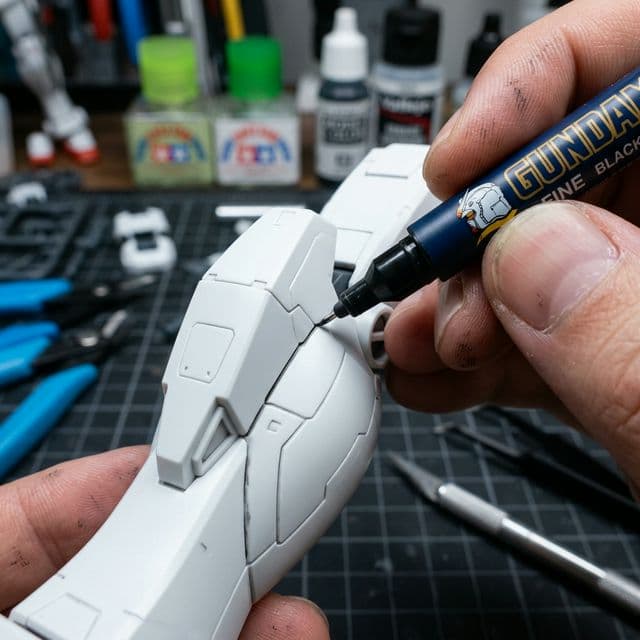
Panel Lining Techniques: Achieving that Pro Finish
If there is one single technique that will elevate your Gunpla from looking like a plastic toy to a miniature mechanical machine, it is Panel Lining.
Bandai engineers model kits with microscopic grooves and indentations meant to simulate armor separation and mechanical paneling. However, out of the box, these details often blend into the solid-colored plastic. By applying dark ink into these recesses, you drastically increase the visual contrast and complexity of your kit.
Here is Gumpla of Miami's quick guide to achieving a pro-grade panel line finish.
1. The Gundam Marker (Fine-Tip)
The absolute best tool for beginners. Bandai produces the classic Gundam Marker (GM01 Black, GM02 Gray, GM03 Brown) specifically for this.- How to use it: Simply trace the lines on the plastic armor. If you over-line or the line looks too thick, immediately wipe it away with your thumb or a cotton swab. The ink will remain in the recess while vanishing from the flat surface.
- Color choices: Use Black for dark colors (blue, gray), Gray for white armor, and Brown for yellow/red armor. Choosing Gray on white instead of Black creates a much more realistic, subtle shadow.
2. Pour-Type Markers
These markers work entirely differently. Instead of drawing, you press the tip against an intersection in the panel line, and the ultra-thin ink flows through capillary action along the groove automatically!- Warning: Do not use pour-types on ABS plastic (often used in older inner frames) as the solvent can make the plastic brittle and cause it to shatter under pressure. Stick to PS (Polystyrene) armor plates.
3. Tamiya Panel Line Accent Color
The gold standard for pro builders. This is essentially thinned enamel paint in a bottle with a tiny brush attached to the cap.- The method: You apply a tiny dot of the wash into a line, let capillary action pull the ink down the groove, and let it dry for 10 minutes.
- The clean-up: Once dry, lightly dip a pointed cotton swab in lighter fluid (Zippo/Ronsonol) or enamel thinner, dab the excess off on a paper towel, and gently wipe over the armor surface. The lighter fluid cleans up the overspill effortlessly without damaging the plastic beneath.
Final Thoughts
Panel lining works best on models that have not been top-coated yet, directly on the bare plastic, or over a gloss clear coat. If you try to panel line over a matte coat, the ink will bleed into the rough texture like a marker on a paper towel.Grab some markers from the shop and start practicing on a cheap Entry Grade—you'll be amazed at the difference!
Related Dispatches
How to Safely Remove Nub Marks Without Damaging Plastic
Say goodbye to ugly white stress marks! Master the double-cut method and glass file techniques for flawlessly clean armor pieces.
Building Your First Custom Diorama for Gunpla
Bring your models to life by creating realistic battleground dioramas using foam, basic paints, and household materials.
Scribing New Panel Lines: Tools and Techniques
Turn a plain, flat piece of armor into a mechanical masterpiece. Learn how to confidently scribe your own custom panel lines.